
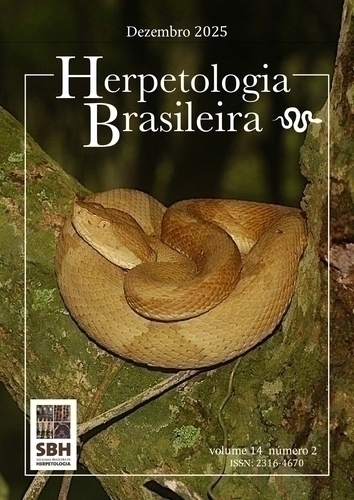
O tripé do Instituto Butantan para evitar a extinção da jararacailhoa
DOI:
https://doi.org/10.5281/zenodo.17361040Keywords:
Golden Lancehead, ex situ conservation, research, environmental education, reintroductionAbstract
The Golden Lancehead, endemic to Queimada Grande Island and critically endangered, requires swift, integrated action. We present the Butantan Institute’s tripod to prevent extinction: research, ex situ conservation, and education. In the research axis, we are consolidating studies and approaches in natural history, behavioral ecology, reproductive physiology, genetics, and microbiota, providing baselines for management, pairings, and assisted-reproduction protocols. For ex situ conservation, the Laboratório de Ecologia e Evolução (LEEv) at Instituto Butantan is developing a vivarium designed to replicate, as far as feasible, the island’s Atlantic Forest structure and microclimate, promoting ecological and behavioral health, reducing inbreeding, and building a stock suitable for future reintroductions. In education, initiatives within LEEv facilities and in coastal schools engage teachers, students, and the public through participatory science, strengthening social support and curbing illegal trade. Integrating these axes offers a replicable framework for other Brazilian snakes and increases the species’ population viability.
References
Abrahão C.R., Amorim L.G.S., Magalhães A.M., Azevedo C.R., Grisi-Filho J.H.H., Dias R.A. 2021. Extinction risk evaluation and population size estimation of Bothrops insularis (Serpentes: Viperidae), a critically endangered insular pitviper species of Brazil. South American Journal of Herpetology 19:32–39.
Alencar L.R., Gaiarsa M.P., Martins M. 2013. The evolution of diet and microhabitat use in pseudoboine snakes. South American Journal of Herpetology 8:60–66.
Amaral A. 1921. Contribuição para o conhecimento dos ophidios do Brasil. A Parte II. Biologia da nova espécie, Lachesis insularis. Memórias do Instituto Butantan 1:39–44.
Amorim L.G.S., Santos-Azevedo W., Azevedo C.R., Almeida-Santos S.M. 2019. First record of mating of Bothrops insularis (Serpentes: Viperidae) in nature, with comments on sexual behavior. Herpetology Notes 12:225–227.
Armelin H.A. 2009. Ciência e inovação em biomedicina. Cadernos de História da Ciência 5:21–34.
Alves-Nunes J.M., Fellone A., Sazima I., Marques O.A.V. 2023. Overcoming the phantoms of the past: Influence of predatory stimuli on the antipredator behavior of island pitvipers. PLoS One 18:e0288826.
Banci K.R.S. 2023. Aspectos sobre história natural e ecologia da jararaca-ilhoa, Bothrops insularis (Serpentes, Viperidae). Tese de Doutorado em Biodiversidade. Universidade Estadual Paulista Júlio de Mesquita Filho.
Banci K.R.S., Eterovic A., Marinho P.S., Marques O.A.V. 2020. Being a bright snake: Testing aposematism and mimicry in a neotropical forest. Biotropica 2020:1–13.
Banci K.R.S., Siqueira L.H.C., Torello-Viera N.F., Marques O.A.V. 2024. Differential predation pressure on island pit vipers shape their niches and defensive behavior. Amphibia-Reptilia 45:465–477.
Bonney R., Phillips T.B., Ballard H.L., Enck J.W. 2015. Can citizen science enhance public understanding of science? Public Understanding of Science 25:2–16.
Bovo R.P., Marques O.A.V., Andrade D.V. 2012. When basking is not an option: Thermoregulation of a viperid snake endemic to a small island in the South Atlantic of Brazil. Copeia 2012:408–418.
Brooks T.M., Mittermeier R.A., Da Fonseca G.A., Gerlach J., Hoffmann M., Lamoreux J.F., Rodrigues A.S. 2006. Global biodiversity conservation priorities. Science 313:58–61.
Frankham R., Ballou J.D., Briscoe D.A. 2017. Introduction to Conservation Genetics and Genomics. 3rd ed. Cambridge University Press, Cambridge.
Garcia V.C., Amorim L.G.S., Almeida-Santos S.M. 2022. Morphological and structural differences between the hemipenes and hemiclitores of golden lancehead snakes, Bothrops insularis (Amaral, 1922), revealed by radiography. Anatomia, Histologia, Embryologia 1:1–4.
Garcia V.C., Almeida-Santos S.M. 2022. Reproductive cycles of two island pitvipers species (Serpentes, Viperidae) determined by ultrasonography and radiography. Anatomia, Histologia, Embryologia 53:1–9.
Garcia V.C., Amorim L.G.S., Esteves R.G., Carvalho-Silva A.M.P.T., Almeida-Santos S.M. 2023. Ultrasonographic and radiographic evaluation of gestation in golden lanceheads (Bothrops insularis) in ex situ breeding programs. Zoo Biology 1:1–5.
Hoge A.R., Belluomini H.E., Schreiber G., Penha A.M. 1959. Sexual abnormalities in Bothrops insularis (Amaral) 1921 (Serpentes). Memórias do Instituto Butantan 29:17–88.
Ibáñez N., Wen F.H., Fernandes S.C.G. 2005. Instituto Butantan: História Institucional – Desenho metodológico para uma periodização preliminar. Cadernos de História da Ciência 1:115–144.
Kasperoviczus K.N., Almeida-Santos S.M. 2012. Instituto Butantan e a Jararaca-ilhoa: cem anos de história, mitos e ciência. Cadernos de História da Ciência 8:255–269.
Kasperoviczus K.N., Braz H.B.P., Amorim L.G.S., Almeida-Santos S.M. 2023. Reproductive strategies of the Golden Lancehead, Bothrops insularis, from Queimada Grande Island – Constraints and Challenges. p. 55–66. In Lillywhite H.L., Martins M. (Org.). Islands and Snakes – Diversity and Conservation. Oxford University Press, New York.
Kurtz B.C., Souza V.C., Magalhães A.M., Paula-Souza J., Duarte A.R., Joaquim-Jr G.O. 2017. The vascular flora and vegetation of Queimada Grande Island, São Paulo state, southeastern Brazil. Biota Neotropica 17:e20170336.
Lewinsohn T.M., Prado P.I. 2005. How many species are there in Brazil? Conservation Biology 19:619–624.
Marques O.A.V. 2021. A Ilha das Cobras: Biologia, evolução e conservação da jararaca-ilhoa na Queimada Grande. Editora Ponto A, São Paulo.
Marques O.A.V., Martins M., Sazima I. 2002. A jararaca da Ilha da Queimada Grande. Ciência Hoje 31:56–59.
Marques O.A.V., Martins M., Develey P.F., Macarrão A., Sazima I. 2012. The golden lancehead Bothrops insularis (Serpentes: Viperidae) relies on two seasonally plentiful bird species visiting its island habitat. Journal of Natural History 46:885–895.
Marques O.A.V., Kasperoviczus K.N., Almeida-Santos S.M. 2013. Reproductive ecology of the threatened pitviper Bothrops insularis from Queimada Grande Island, Southeast Brazil. Journal of Herpetology 47:393–399.
Martins M., Marques O.A.V., Sazima I. 2002. Ecological and phylogenetic correlates of feeding habits in neotropical pitvipers of the genus Bothrops. pp. 307–328. In G. Schuett, M. Höggren, H.W. Greene (Org.). Biology of the Vipers. Carmel: Biological Sciences Press.
Martins M., Sawaya R.J., Marques O.A.V. 2008. A first estimate of population size of the critically endangered lancehead, Bothrops insularis. South American Journal of Herpetology 3:168–174.
Maschio G.F., Costa S., Marques O.A.V. 2023. Estudos de história natural de serpentes no Brasil: da ascensão à extinção. Herpetologia Brasileira 12:32–55.
Salles-Oliveira I., Machado T., Banci K.R.S., Almeida-Santos S.M., Silva M.J.J. 2020. Genetic variability, management and conservation implications of the critically endangered Brazilian pitviper Bothrops insularis. Ecology and Evolution 10:1–13.
Sawaya R.J., Barbo F.E., Grazzotin F., Marques O.A.V., Martins M. 2023. Lanceheads in land-bridge islands of Brazil. pp. 67–80. In Lillywhite H.L., Martins M. (Org.). Islands and Snakes – Diversity and Conservation. Oxford University Press, New York.
Silva K.B., Zogno M.A., Camillo A.B., Pereira R.J.G., Almeida-Santos S.M. 2015. Annual changes in seminal variables of golden lancehead pitvipers (Bothrops insularis) maintained in captivity. Animal Reproduction Science 163:144–150.
Silva K.B., Frediani M.H., Angrimani D.S.R., Coeti R., Pereira R.J., Nichi M., Almeida-Santos S.M. 2021. Short-term cold storage of seminal samples of the golden lancehead pitviper (Bothrops insularis). Zoo Biology 1:1–5.
Downloads
Published
Issue
Section
License
Copyright (c) 2026 Herpetologia Brasileira

This work is licensed under a Creative Commons Attribution 4.0 International License.