
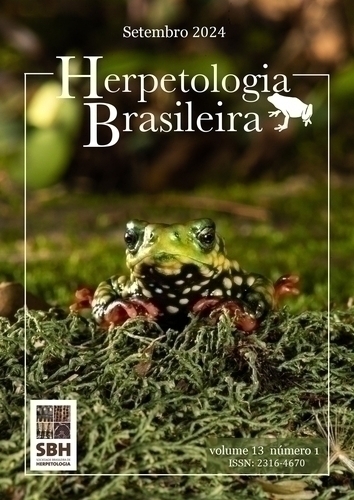
Malformações em cinco espécies de anuros em florestas urbanas do município do Rio de Janeiro, Sudeste do Brasil
DOI:
https://doi.org/10.5281/zenodo.13308125Palavras-chave:
Adenomera marmorata, Anomalias, Aplastodiscus albofrenatus, Brachycephalus ephippium, Deformidades, Hylodes nasus, Ischnocnema guentheriResumo
Estudos sobre malformações ou anomalias morfológicas em anuros têm aumentado nos últimos tempos, principalmente devido à preocupação com o declínio de populações e ao recorrente registro de indivíduos malformados em ambientes alterados. Estudos que analisam estas malformações são mais comuns em localidades perceptivelmente impactadas, tanto devido à potencial contaminação por agrotóxicos ou parasitas causadores destas malformações, quanto devido à observação prévia da proporção de indivíduos malformados. Por outro lado, para áreas com alterações ambientais pouco perceptíveis há poucos estudos. Considerando a metodologia, os estudos concentram-se na descrição da anatomia externa dos espécimes malformados ou anômalos, sendo pouco frequente a avaliação osteológica. Embora os estudos para espécies da região Holártica sejam mais comuns, há um aumento destes estudos em anuros neotropicais. Contudo, a maioria destes artigos descrevem malformações em um ou poucos indivíduos, sendo raros estudos com abordagens populacionais ou experimentais. Neste estudo foram analisados indivíduos de cinco espécies de anuros do município do Rio de Janeiro, sudeste do Brasil. Os espécimes foram radiografados e analisados em microscópio estereoscópico, as malformações foram quantificadas e descritas. Entre 622 espécimes analisados, foram encontrados 20 espécimes malformados: oito Hylodes nasus, seis Aplastodiscus albofrenatus, três Adenomera marmorata, dois Brachycephalus ephippium e um Ischnocnema guentheri, poucas ocorrências como esperado para populações de áreas sem impactos aparentes. Novas categorias de malformações foram encontradas e descritas: Falange Curva e Cintura Pélvica Incompleta.Referências
Ab’Saber A.N. 1977. Os domínios morfoclimáticos da América do Sul. Geomorfologia, 52:1–22.
Agostini M.G., Roesler I., Bonetto C., Ronco A.E., Bilenca D. 2020. Pesticides in the real world: The consequences of GMO-based intensive agriculture on native amphibians. Biological Conservation 241:108355. doi.org/10.1016/j.biocon.2019.108355.
Ascoli-Morrete T., Signor E., Santos-Pereira M., Zanella N. 2019. Morphological abnormalities in anurans from southern Brazil. Austral Ecology 44:1025–1029. doi.org/10.1111/aec.12769.
Blaustein A.R., Wake D.B. 1990. Declining amphibian populations: a global phenomenon? Trends in Ecology & Evolution 5:203–204. doi.org/10.1016/0169-5347(90)90129-2.
Blotto B.L., Pereyra M.O., Grant T., Faivovich J. 2020. Hand and foot musculature of Anura: structure, homology, terminology, and synapomorphies for major clades. Bulletin of the American Museum of Natural History 443:1–156. doi.org/10.1206/0003-0090.443.1.1.
Borkin L.J., Bezman-Moseyko O.S., Litvinchuk S.N. 2012. Evaluation of animal deformity occurrence in natural populations (an example of amphibians). Proceedings of the Zoological Institute RAS 316:324–343. doi.org/10.31610/trudyzin/2012.316.4.324.
Bosch R.A., Marrero A.H., Echevarría J.L.L., Estrada I.H., Castillo L.G., Quintana A.D.T. 2021. Limb abnormalities in Peltophryne florentinoi (Anura: Bufonidae) from Cuba. Phyllomedusa 20:117–123. doi: http://dx.doi.org/10.11606/.
Carmo L.F., Guimarães S.O., Miguel I.R., Pinna P.H., Fernandes D.S., Wojtowicz-Cardoso M. 2021. High prevalence of anomalies in Nyctimantis brumoi (Anura: Hylidae) from a restinga protected area in southeastern Brazil. Phyllomedusa 20:165–179. doi: http://dx.doi.org/10.11606/.
Cuzziol-Baccioni A.P., Peltzer P.M., Martinuzzi C.S., Attademo A.M., León E.J., Lajmanovich R.C. 2020. Morphological and histological abnormalities of the neotropical toad, Rhinella arenarum (Anura: Bufonidae) larvae exposed to dexamethasone. Journal of Environmental Science and Health, Part B 56:1–13. doi.org/10.1080/03601234.2020.1832410.
D’Ávila R.S., Brum B.R., Hurtado T.C., Ignácio A.R.A. 2020. Temporal quantitative analysis on the effects of agricultural use on amphibians – anuran. Research, Society and Development 9:2525–3409. doi.org/10.33448/rsd-v9i8.5682.
Fabrezi M. 1993. The anuran tarsus. Alytes 11:47–63.
Fabrezi M., Alberch P. 1996. The carpal elements of anurans. Herpetologica 52:188–204.
Ferrante L., Fearnside P.M. 2020. Evidence of mutagenic and lethal effects of herbicides on Amazonian frogs. Acta Amazonica 50:363–366. doi.org/10.1590/1809-4392202000562.
De Superville D. 1739. Some Reflections on Generation, and on Monsters, With a Description of Some Particular Monsters. Philosophical Transactions 41:294–307. https://doi.org/10.1098/rstl.1739.0044.
Haschek W.M., Rousseaux C.G., Wallig M.A., Bolon B., Ochoa R. 2013. Haschek and Rousseaux’s handbook of toxicologic pathology. Academic Press, Massachusetts.
Henle K., Dubois A., Vershinin V. 2017a. A review of anomalies in natural populations of amphibians and their potential causes. Mertensiella 25:57–164.
Henle K., Dubois A., Vershinin V. 2017b. Commented glossary, terminology and synonymies of anomalies in natural populations of amphibians. Mertensiella 25:9–48.
Johnson P.T., Chase J.M. 2004. Parasites in the food web: linking amphibian malformations and aquatic eutrophication. Ecology Letters 7:521–526. doi:10.1111/j.1461-0248.2004.00610.x.
Johnson P.T.J., Lunde K.B., Thurman E.M., Ritchie E.G., Wray S.N., Sutherland D.R., Blaustein A.R. 2002. Parasite (Ribeiroia ondatrae) infection linked to amphibian malformations in the western United States. Ecological Monographs 72:151–168. doi.org/10.1890/0012-9615(2002)072[0151:PROILT]2.0.CO;2.
Kaiser J. 1997. Deformed frogs leap into spotlight at health workshop. Science 278:2051–2052. doi:10.1126/science.278.5346.2051.
Kalter H. 2003. Teratology in the 20th century Environmental causes of congenital malformations in humans and how they were established. Neurotoxicology and Teratology 25:131–282. doi:10.1016/B978-044451364-9/50009-7.
Ko S.K. 2020. Effects of pesticides (Benomyl, Carbofuran, Thiobencarb) on the Asian toad (Bufo gargarizans) embryo development. Korean Journal of Environmental Research and Technology 23:131–136.
Kovalenko E.E., Kovalenko Y.I. 1996. Certain pelvic and sacral anomalies in anura. Russian Journal of Herpetology 3:172–177.
Kovalenko E.E., Kruzhkova Y.I. 2013. Individual variation of the common toad, Bufo bufo (Anura, Bufonidae): 2. Diagnostic characters of the axial skeleton. Russian Journal of Developmental Biology 44:180–193. doi.org/10.1134/S1062360413040048.
Lannoo M. 2008. Malformed frogs: the collapse of aquatic ecosystems. University of California Press, Berkeley.
Lannoo M.J. 2009. Amphibian malformations. Pp. 3089–3144, in Heatwole H., Wilkinson J.W. (Eds.), Amphibian Biology, vol. 8. Surrey Beatty & Sons, Baulkham Hills.
Lichtenstein H. 1823. Verzeichniss der Doubletten des zoologischen Museums der Königl. Universität zu Berlin nebst Beschreibung vieler bisher unbekannter Arten von Säugethieren, Vögeln, Amphibien und Fischen. T. Trautwein, Berlin.
Lutz A. 1924. Sur les rainettes des environs de Rio de Janeiro. Comptes Rendus et Mémoires Hebdomadaires des Séances de la Société de Biologie et des ses Filiales. Paris 90:241.
Martínez M.M., Botero V.S. 2019. An alarm case? Hindlimb malformation in the endemic Colombian glass frog, Sachatamia punctulata (Anura, Centrolenidae). Herpetology Notes 12:919–921.
Meteyer C.U. 2000. Field guide to malformations of frogs and toads with radiographic interpretations. Biological Science Report USGS/BRD/BSR-2000-0005.
Meteyer C.U., Cole R.A., Converse K.A., Docherty D.E., Wolcott M., Helgen J.C., Burkhart J.G. 2000. Defining anuran malformations in the context of a developmental problem. The Journal of the Iowa Academy of Science 107:72–78.
Netto A.L.C. 2005. A interface florestal-urbana e os desastres naturais relacionados à água no maciço da tijuca: desafios ao planejamento urbano numa perspectiva sócio-ambiental. Revista do Departamento de Geografia 16:46–60. doi:10.7154/RDG.2005.0016.0005.
Ouellet M., Bonin J., Rodrigues J., Desgranges J., Lair S. 1997. Hindlimb deformities (Ectromelia, Ectrodactyly) in free-living anurans from agricultural habitats. Journal of Wildlife Diseases 33:95–104. doi:10.7589/0090-3558-33.1.95.
Ouellet M. 2000. Amphibian deformities: current stage of knowledge. Pp. 617–661, in Sparling D.W., Linder G., Bishop C.A. (Eds.), Ecotoxicology of amphibians and reptiles. SETAC Technical Publications Series, Society of Environmental Toxicology and Chemistry, Pensacola.
Pedrozo-Santos F., Sanches P.R., Sousa J.C., Costa-Campos E. 2020. Anomalies in amphibians from the eastern Amazon region. The Herpetological Bulletin 153:22–25. doi.org/10.33256/hb153.2225.
Peloso P.L. 2016. Osteological malformation in the tree frog Hypsiboas geographicus (Anura: Hylidae). Phyllomedusa 15:91–93. doi: http://dx.doi.org/10.11606/.
Peltzer P.M., Lajmanovich R.C., Sanchez L.C., Attademo A.M., Junges C.M., Bionda C.L., Basso A. 2011. Morphological abnormalities in amphibian populations. Herpetological Conservation and Biology 6:432–442.
Portela A.A.B., Santos T.G., Anjos L.A. 2020. Changes in land use affect anuran helminths in the South Brazilian grasslands. Journal of Helminthology 94:1–11. doi: http://dx.doi.org/10.1017/S0022149X20000905.
Price E.W. 1931. Four new species of trematode worms from the muskrat, Ondatra zibethica, with a key to the trematode parasites of the muskrat. Proceedings of the United States National Museum 79:1–13. doi:10.5479/si.00963801.79-2870.1.
Rebouças R., Silva H.R., Solé M. 2019. Malformations in insular and coastal populations of toads in Rio de Janeiro, Southeastern Brazil. South American Journal of Herpetology 14:12–18. doi: http://dx.doi.org/10.2994/SAJH-D-17-00031.1.
Reeves M.K., Medley K.A., Pinkney A.E., Johnson P.T.J., Lannoo M.J. 2013. Localized hotspots drive continental geography of abnormal amphibians on U.S. wildlife refuges. PLoS One 8:1–14. doi: http://dx.doi.org/10.1371/journal.pone.0077746.
Shin Y., Jang Y., Borzee A. 2020. Limb malformations in Bombina orientalis (Anura: Bombinatoridae) in the Republic of Korea based on museum specimens. Herpetology Notes 13:29–31.
Silva M.B., Fraga R.E., Nishiyama P.B., Silva I.S.S., Costa N.L.B., Oliveira L.A.A., Juncá F.A. 2020. Leukocyte profiles in Odontophrynus carvalhoi (Amphibia: Odontophrynidae) tadpoles exposed to organophosphate chlorpyrifos pesticides. Water Air Soil Pollution 231:372. doi: http://dx.doi.org/10.1007/s11270-020-04726-4.
Spix J.B. von. 1824. Animalia nova sive species novae Testudinum et Ranarum quas in itinere per Brasiliam annis MDCCCXVII–MDCCCXX jussu et auspiciis Maximiliani Josephi I. Bavariae Regis. F. S. Hübschmann, Monachii.
Steindachner F. 1864. Batrachologische Mittheilungen. Verhandlungen des Zoologisch-Botanischen Vereins in Wien 14:239–288.
Steindachner F. 1867. Reise der österreichischen Fregatte Novara um die Erde in den Jahren 1857, 1858, 1859 unter den Befehlen des Commodore B. von Wüllerstorf-Urbair. Pt. 9, Bd. 1, Abt. 4, Zoologischer Theil. Amphibien. K. K. Hof- und Staatsdruckerei, Wien.
Svinin A.O., Bashinskiy I.V., Litvinchuk S.N., Ermakov O.A., Ivanov A.Y., Neymark L.A., Dubois A. 2020. Strigea robusta causes polydactyly and severe forms of Rostand’s anomaly P in water frogs. Parasites & Vectors 13:381. doi: https://doi.org/10.1186/s13071-020-04256-2.
Toledo L.F., Ribeiro R.S. 2009. The Archipelago of Fernando de Noronha: an intriguing malformed toad hotspot in South America. EcoHealth 6:351–357. doi:10.1007/s10393-010-0277-2.
Tolledo J., Toledo L.F. 2015. Blind toads in paradise: the cascading effect of vision loss on tropical archipelago. Journal of Zoology 296:167–176. https://doi.org/10.1111/jzo.12233.
Yu S., Wages M.R., Cai Q., Maul J.D., Cobb G.P. 2013. Lethal and sublethal effects of three insecticides on two developmental stages of Xenopus laevis and comparison with other amphibians. Environmental Toxicology and Chemistry 32:2056–2064. doi:10.1002/etc.2280.
Downloads
Publicado
Edição
Seção
Licença
Direitos autorais (c) 2026 Herpetologia Brasileira

Este trabalho está licenciado sob uma licença Creative Commons Attribution 4.0 International License.