
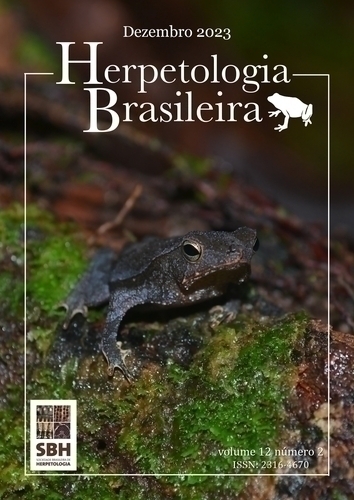
New record and geographic distribution of Physalaemus nattereri (Steindachner, 1863) in the state of Piauí, northeastern Brazil
DOI:
https://doi.org/10.5281/zenodo.10204710Referencias
Aquino L., Reichle S., Silvano D., Scott N. 2004. Physalaemus nattereri. The IUCN Red List of Threatened Species 2004: e.T57267A11597340. doi: 10.2305/IUCN.UK.2004.RLTS.T57267A11597340.en. Accessed on 04 April 2023.
Andrade Júnior A.S., Bastos E.A., Barros A.H.C., Silva C.O., Gomes A.A.N. 2005. Classificação climática e regionalização do semiárido do Estado do Piauí sob cenários pluviométricos distintos. Revista Ciência Agronômica 36:143–151.
Araújo K.C., Ribeiro A.S., Andrade E.B., Pereira O.A., Guzzi A., Ávila R.W. 2020a. Herpetofauna of the Environmental Protection Area Delta do Parnaíba, Northeastern Brazil. Cuadernos de Herpetología 34:185–199.
Araújo K.C., Andrade E.B., Brasileiro A.C., Bêncio R.A., Sena F.P., Silva R.A., Ávila R.W. 2020b. Anurans of Sete Cidades National Park, Piauí state, northeastern Brazil. Biota Neotropica 20:e20201061. doi: 10.1590/1676-0611-BN-2020-1061.
Brandão M.L.S.M., Alencar G.S., Rocha I.L., Iwata B.F. 2022. Zoneamento ecológico-econômico da Floresta Nacional de Palmares, Altos, Piauí (Brasil). Revista Ibero-Americana de Ciências Ambientais 13:21–35. doi: 10.6008/CBPC2179-6858.2022.003.0002.
Brasileiro C.A., Lucas E.M., Oyamaguchi H.M., Thomé M.T.C., Dixo M. 2008. Anurans, Northern Tocantins River Basin, states of Tocantins and Maranhão, Brazil. Check List 4:185–197. doi: 10.15560/4.2.185.
Carvalho T.R., Angulo A., Barrera D.A., Aguilar-Puntriano C., Haddad C.F.B. 2020. Hiding in Plain Sight: A Fourth New Cryptic Species of the Adenomera andreae Clade (Anura: Leptodactylidae) from Southwestern Amazonia. Herpetologica 76:304–314. doi: 10.1655/Herpetologica-D-19-00068.1.
Carvalho T.R., Fouquet A., Lyra M.L., Giaretta A.A., Costa-Campos C.E., Rodrigues M.T., Ron S.R. 2022. Species diversity and systematics of the Leptodactylus melanonotus group (Anura, Leptodactylidae): review of diagnostic traits and a new species from the Eastern Guiana Shield. Systematics and Biodiversity 20:1–31. doi: 10.1080/14772000.2022.2089269.
CRIA. 2023. Centro de Referência e Informação Ambiental. SpeciesLink simple search. Available in https://specieslink.net. Accessed in April 2023.
Fiorillo B.F., Faggioni G.P., Cerezef F.O., Becker C.G., Díaz-Ricaurte J.C., Martins M. 2023. Effects of environmental factors on the ecology and survival of a widespread, endemic Cerrado frog. Biotropica 55:551–562. doi: 10.1111/btp.13209.
Fitzinger L.J.F.J. 1826. Neue Classification der Reptilien nach ihren Natürlichen Verwandtschaften nebst einer Verwandtschafts-Tafel und einem Verzeichnisse der Reptilien-Sammlungen des K.K. Zoologischen Museum’s zu Wien. Wien: J. G. Heubner.
Ribeiro A.T. 2017. Caracterização da cobertura vegetal e uso do solo no município de Uruçuí, Piauí, Brasil. Nativa 5:337–341. doi: 10.31413/nativa.v5i5.4443.
Frost D.R. 2023. Amphibian Species of the World: an Online Reference. Version 6.1 (accessed on 05 April 2023). Electronic Database accessible at https://amphibiansoftheworld.amnh.org/index.php. American Museum of Natural History, New York, USA. doi: 10.5531/db.vz.0001.
Giaretta A.A., Facure K.G. 2006. Terrestrial and communal nesting in Eupemphix nattereri (Anura, Leiuperidae): interactions with predators and pond structure. Journal of Natural History 40:2577–2587. doi: 10.1080/00222930601130685.
IBGE. 2019. Instituto Brasileiro de Geografia e Estatística, Coordenação de Recursos Naturais e Estudos Ambientais. Biomas e sistema costeiro-marinho do Brasil: compatível com a escala 1:250000. Série Relatórios Metodológicos. IBGE, Rio de Janeiro.
Ibiapina R.A., Carvalho Júnior D.A. 2012. “No meio do caminho tinha uma pedra”: O Sítio Arqueológico Pedra do Letreiro em Boa Hora – Piauí. Pp. 1–7, in VI Simpósio Nacional de História Cultural. Universidade Federal do Piauí, Teresina.
ICMBio. 2019. Instituto Chico Mendes de Conservação da Biodiversidade. Floresta Nacional de Palmares. Available in: http://www.icmbio.gov.br/portal/visitacao1/unidades-abertas-a-visitacao/4059-flona-de-palmares. Accessed on 05 April 2023.
IUCN. 2023. The IUCN Red List of Threatened Species. Version 2023-1. Available at http://www.iucnredlist.org. Last accessed: 05 April 2023.
Ivanov M.M.M. 2020. Unidades de conservação do estado do Piauí. EDUFPI, Teresina.
Leal F., Zornosa-Torres C., Augusto-Alves G., Dena S., Pezzuti T.L., Leite F., Toledo L.F. 2021. Head in the clouds: a new dwarf frog species of the Physalaemus signifer clade (Leptodactylidae, Leiuperinae) from the top of the Brazilian Atlantic Forest. European Journal of Taxonomy 764:119–151. doi: 10.5852/ejt.2021.764.14175.
Lenzi-Mattos R., Antoniazzi M.M., Haddad C.F.B., Tambourgi D.V., Rodrigues M.T., Jared C. 2005. The inguinal macroglands of the frog Physalaemus nattereri (Leptodactylidae): structure, toxic secretion and relationship with deimatic behaviour. Journal of Zoology 266:385–394. doi: 10.1017/S095283690500703X.
Lima M.S.C.S., Pederassi J., Pineschi R.B., Barbosa D.B.S. 2019. Acoustic niche partitioning in an anuran community from the municipality of Floriano, Piauí, Brazil. Brazilian Journal of Biology 79:566–576. doi: 10.1590/1519-6984.180399.
Lima M.S.C.S., Pineschi R.B., Pederassi J., Caramaschi C., Santos M.C.O., Silva I.C., Souza P.S. 2018. Bioacústica dos anfíbios anuros do Centro Sul do Piauí. EDUFPI, Teresina.
Lourenço L.B., Targueta C.P., Baldo D., Nascimento J., Garcia P.C., Andrade G.V., Haddad C.F.B., Recobre-Pimentel S.M. 2015. Phylogeny of frogs from the genus Physalaemus (Anura, Leptodactylidae) inferred from mitochondrial and nuclear gene sequences. Molecular Phylogenetics and Evolution 92:204–216. doi: 10.1016/j.ympev.2015.06.011.
Lynch J.D. 1971. Evolutionary relationships, osteology, and zoogeography of leptodactyloid frogs. Miscellaneous publication – University of Kansas, Museum of Natural History 53:1–238. https://biostor.org/reference/59550.
Luebert F. 2021. The two South American dry diagonals. Frontiers of Biogeography 13:e51267. doi: 10.21425/F5FBG51267.
Nascimento L.B., Caramaschi U., Cruz C.A.G. 2005. Taxonomic review of the species groups of the genus Physalaemus Fitzinger, 1826 with revalidation of the genera Engystomops Jiménez-de-la-Espada, 1872 and Eupemphix Steindachner, 1863 (Amphibia, Anura, Leptodactylidae). Arquivos do Museu Nacional 63:297–320.
Roberto I.J., Ribeiro S.C., Loebmann D. 2013. Amphibians of the state of Piauí, Northeastern Brazil: a preliminary assessment. Biota Neotropica 13:322–330. doi: 10.1590/S1676-06032013000100031.
Sánchez-Domene D., Silva F.R., Provete D.B., Navarro-Lozano A., Acayaba R.D., Montagner C.C., Almeida E.A. 2023. Combined effects of landscape composition and agrochemicals on frog communities amid sugarcane-dominated agroecosystems. Ecological Applications 33:e2781. doi: 10.1002/eap.2781.
Sazima I., Caramaschi U. 1986. Descrição de Physalaemus deimaticus, sp. n., e observações sobre comportamento deimático em P. nattereri (Steindn.). Anura, Leptodactylidae. Revista de Biologia 13:91–101.
Segalla M., Berneck B., Canedo C., Caramaschi U., Cruz C.A.G., Garcia P.D.A., … Langone J.A. 2021. List of Brazilian Amphibians. Herpetologia Brasileira 10:121–216. doi: 10.5281/zenodo.4716176.
Steindachner F. 1863. Über einige neue Batrachier aus den Sammlungen des Wiener Museums. Sitzungsberichte der Kaiserlichen Akademie der Wissenschaften, Mathematisch-Naturwissenschaftliche Classe 48:186–192.
Vaz-Silva W., Maciel N.M., Nomura F., de Morais A.R., Batista V.G., Santos D.L., Bastos R.P. 2020. Guia de Identificação das Espécies de Anfíbios (Anura e Gymnophiona) do Estado de Goiás e do Distrito Federal, Brasil Central. Sociedade Brasileira de Zoologia, Curitiba. doi: 10.7476/9786587590011.
Veloso M.D.C., Andrade Junior A.S., Vasconcelos L., Azevedo D.M.P., Sousa M.J.S. 2018. Avaliação de cultivares de cana-de-açúcar para a agricultura familiar no município de Boa Hora, PI. Embrapa Meio Norte, Teresina.
Descargas
Publicado
Número
Sección
Licencia
Derechos de autor 2026 Herpetologia Brasileira

Esta obra está bajo una licencia internacional Creative Commons Atribución 4.0.